
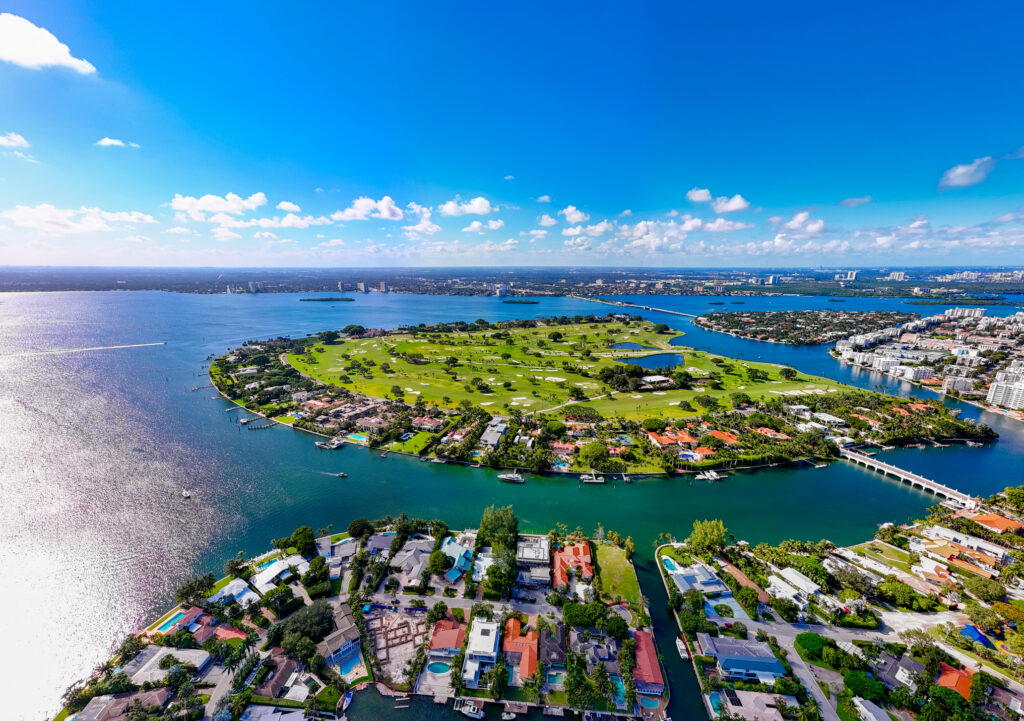
In August 2026, a house on Hibiscus Island sold for $51.5 million.
The number itself is impressive, but what caught my attention was what it beat. The previous record on Palm and Hibiscus Islands was roughly $40 million, and that sale involved a larger residence on a larger lot. Yet this property sold for over $11 million more.
This transaction underscores a fundamental rule to keep in mind when analyzing Miami waterfront lot values: lot size alone does not determine market worth. Two Miami waterfront lots can have almost identical square footage yet command radically different prices based on their type of water access, sightlines, buildability, and potential development timeline.
The 270 S. Hibiscus Drive property consists of two lots totaling approximately 21,000 square feet, featuring 120 linear feet of water frontage and dual private docks capable of accommodating a 105-foot yacht. At $51.5 million, this sale translates to roughly $2,450 per square foot of land and $429,000 per linear foot of waterfront (the two core metrics driving true Miami waterfront property values).
The Two Numbers Behind Miami Waterfront Lot Values
Everyone in Miami talks about price per square foot of living area. This is an important metric, but it becomes much less useful when the house is not the most valuable part of the property. With older Miami waterfront homes in particular, the underlying land often carries the majority of the asset’s value.
To determine what a Miami waterfront lot is worth, smart valuation separates the structure from the dirt using two primary benchmarks:
- Price per Square Foot of Land: The overall purchase price divided by total lot area, This establishes a baseline for comparing underlying land from one sale to another.
- Price per Linear Foot of Waterfront: The ultimate measure of scarcity. You can renovate, expand, or demolish a residence, but you cannot manufacture additional water frontage.
Case Study: How Waterfront Property Quality Created a $10 Million Value Gap
Comparing two recent sales of near-identical lot sizes reveals more about what drives Miami waterfront lot values.
In May, 2026, 220 Bal Bay Drive sold for $31 million ($1,476/sq ft of land). The property featured a 3,500-square-foot 1960s house marketed primarily as a teardown.
Three months later, 270 S. Hibiscus Drive sold for $51.5 million ($2,450/sq ft of land). Despite possessing matching 21,000-square-foot footprints, the properties traded nearly $1,000 per square foot of land apart.
The price gap reflects buyer risk and readiness:
- The Bal Harbour buyer acquired a land opportunity requiring architectural design, municipal permitting, carrying costs, and years of construction.
- The Hibiscus Island buyer paid a premium for turn-key luxury, guard-gated privacy, and substantial protected dockage.
How Water Frontage Features and Views Dictate Lot Value
Not all water is created equal. The physical characteristics of the water directly in front of your property establish its functional limit and valuation ceiling.
1. Navigational Access & Water Depth
Waterfront linear footage means very little if marine navigation is restricted. Key factors include:
- Bridge Clearance: Properties constrained by fixed bridges strictly limit the size and type of vessel that can dock, excluding large center consoles, sailboats, and mega-yachts.
- Draft & Basin Depth: Deep-water access without draft limitations commands a substantial premium over shallow canals that require careful tide timing.
- Turning Basin: Wide canals and open water allow larger vessels to maneuver safely, directly impacting dock usability.
2. View Corridors & Exposure
Sightlines function as permanent natural amenities:
- Open Bay vs. Canal: Unobstructed wide-water views create light, breeze, and privacy that adjacent properties cannot build out.
- Orientation: Primary sunset exposures (western view) consistently command top-tier market positioning.
There’s no MLS field that neatly explains what each of these characteristics is worth. Buyers don’t tell us that they paid an extra $2 million for water depth or an unobstructed western exposure. But you can see it in the completed sales data if you know what to look for. The market makes it crystal clear that the quality of the waterfront matters.
Seawall Condition: Eliminating Buyer Discounting
Seawalls frequently create friction during escrow. Waterfront buyers fear seawall issues not simply because of repair or replacement expense, but because of regulatory delays, engineering uncertainty, and potential structural liability.
Concrete panel seawall replacements in South Florida typically run $250 to $400 per linear foot installed, not including engineering, environmental mitigation, and municipal permitting costs. Furthermore, municipalities like Miami Beach require new seawalls to meet a minimum elevation of 5.7 feet NAVD88 (North American Vertical Datum of 1988, the modern national standard used to measure land elevation and sea-level rise compliance).
On an eight-figure asset, a seawall repair represents a relatively small percentage of the property’s overall value. However, most buyers strongly dislike uncertainty. Those who find themselves asking, “What needs to be done? What will it cost? What permits are required? How long will it take? What happens if additional problems are discovered?” will often use these unknowns as negotiating leverage. Commissioning a professional engineering inspection prior to listing removes guesswork, neutralizes low-ball negotiating tactics, and preserves land value.
Scarcity in a Tightening Market: The Shift Toward Land Value
When a property’s land value eclipses the value of its physical home, market dynamics change rapidly.
Consider 3085 Munroe Drive in Coconut Grove:
- 2021 Purchase Price: $45.9 million
- January 2026 Sale Price: $71.9 million (57% appreciation)
The 10,400-square-foot structure did not expand or undergo a massive overhaul during those five years. The 57% value spike was overwhelmingly driven by the soaring cost of the underlying bayfront land.
This trend is reinforced by broader market inventory shifts:
- Miami-Dade single-family inventory fell 22.82% year over year in July 2026 (from 5,539 active listings to 4,275). That represents approximately 4.8 months of supply.
- Sales of homes priced at $1 million and above also increased 15.5% (from 341 to 394).
With single-family inventory down nearly 23%, luxury volume rising, and sustained wealth migration to South Florida, Miami waterfront lots have become increasingly difficult to find. And we cannot manufacture more.
This is why (particularly with Miami’s best waterfront properties) owners need to understand both the value of the home itself and the value of the land beneath it. Owners of older homes often focus on interior cosmetic issues, while high-net-worth buyers are asking themselves: What would it cost me to own this piece of Miami waterfront if the house weren’t here? That answer can be a much more lucrative number for a seller.
What Is Your Miami Waterfront Lot Actually Worth?
Valuing an older waterfront home requires analyzing the asset from the water inward:
- Evaluate the Waterfront Quality: Check depth, bridge restrictions, turning clearance, dockage capability, and exposure.
- Audit the Substructure: Confirm seawall elevation (NAVD88) and structural integrity.
- Appraise the Structure: Determine whether the existing home adds net value or serves primarily as a footprint for redevelopment. If the latter, what type and size of structure can be built?
This leads to another question I hear frequently: Is open bay really worth the premium over a good wide canal? The answer is more nuanced than yes or no, and I’ll address that separately in the next few weeks.
If you own an older waterfront home in Miami and want to understand how today’s market evaluates your land versus your structure, let’s connect for an in-depth market analysis.
If you’d like to receive my posts in your inbox each week, subscribe to my Substack.
Barbara Gretsch is a REALTOR® with Berkshire Hathaway HomeServices EWM Realty, serving Miami and South Florida’s $1M+ residential market, including Coconut Grove, Coral Gables, The Roads, Brickell, Key Biscayne and Miami Beach. barbaragretsch.com