
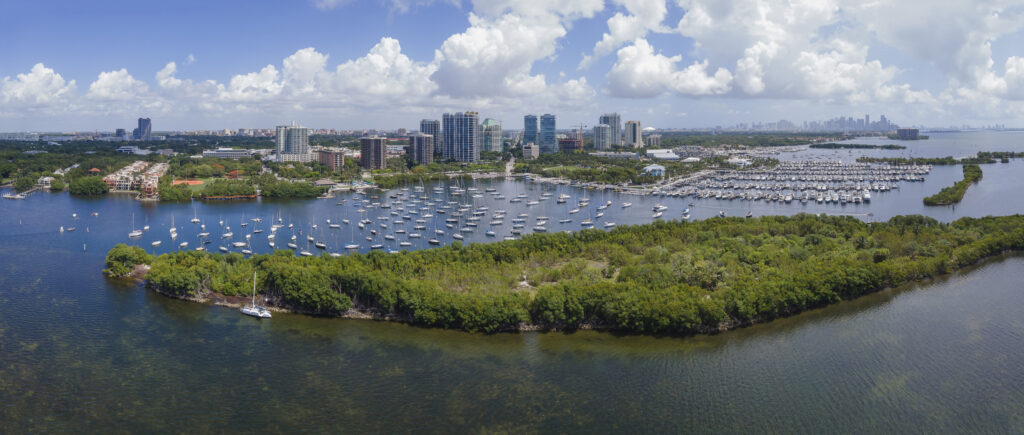
The Hidden Side of Miami: Discover why Coconut Grove remains Miami’s most resilient real estate market.
Coconut Grove doesn’t try too hard. It never has. You feel it the second you turn off South Bayshore and disappear under the trees. The light changes. The streets stop making sense in a traditional grid kind of way. You slow down whether you meant to or not. That’s because the Grove wasn’t built the way the rest of Miami was. It didn’t follow a blueprint; it simply evolved.
A Legacy of Quiet Intent
Long before the glass towers of Brickell and Miami Beach hotels, there were settlers here—Bahamian families, artists, and writers—carving out a life in the late 1800s. They weren’t looking to build big. They were looking for the shade, the water, and a sense of removal from the world’s noise. Remarkably, that original spirit hasn’t been engineered out of the Grove. In a city that reinvents itself every decade, that’s a rarity.
Architecture Without an Agenda
When Coconut Grove was developing, there was no master plan forcing symmetry. That organic lack of pretension continues today. Streets bend unexpectedly. Lots vary wildly. Houses sit back, or don’t. next to something that feels like it’s been there for decades, because it probably has.
And then there are the trees. Not “landscaping.” Not staged. Actual canopy. The kind of greenery that takes generations, not budgets, to grow. You can’t manufacture this atmosphere. Many have tried, but it never quite lands the same.
The Modern Tug-of-War
Over time, the Grove has gone through phases. Quiet enclave. Bohemian pocket. Interest from developers. The tension between what stays and what gets replaced. You see it now more than ever. A teardown next to a preserved home. A clean, modern build sitting where something more layered used to be. Some of it works. Some of it feels like it missed the point entirely.
Why the Grove Holds Its Own
Buyers who understand the Grove aren’t just acquiring square footage. They’re paying for the feeling of being slightly removed while remaining in the center of everything. They’re investing in privacy without isolation, and character that doesn’t require a sales pitch. It isn’t loud, and it isn’t performing for anyone—which is precisely why it’s so impressive.
In a market like Miami, where so much of the conversation is about newness and scale, Coconut Grove holds its value differently. There’s only so much of it, and there always will be. You can build more condos, but you can’t build more Grove.
The Verdict
I’ve been saying this a lot lately, but it shows up here particularly clearly. Most homes don’t have a demand problem. They have a product problem. Real estate in The Grove doesn’t have that issue when it’s done right. If you’ve spent time there, you know. If you haven’t, it’s worth seeing in person. The Grove is one of the few places in Miami that still feels like it belongs entirely to itself.
Barbara Gretsch · Miami Real Estate
Buying or Selling in Miami?
Tell me what you are looking for and I will give you a straight answer, grounded in real market data.
If you would like to receive my posts in your inbox each week, subscribe to my Substack here.
Barbara Gretsch is a REALTOR® with Berkshire Hathaway HomeServices EWM Realty, serving Miami and South Florida’s $1M+ residential market, including Coconut Grove, Coral Gables, The Roads, Brickell, Key Biscayne, and Miami Beach. barbaragretsch.com