
Unlocking Miami Land Values: Should You Value the House or the Land?
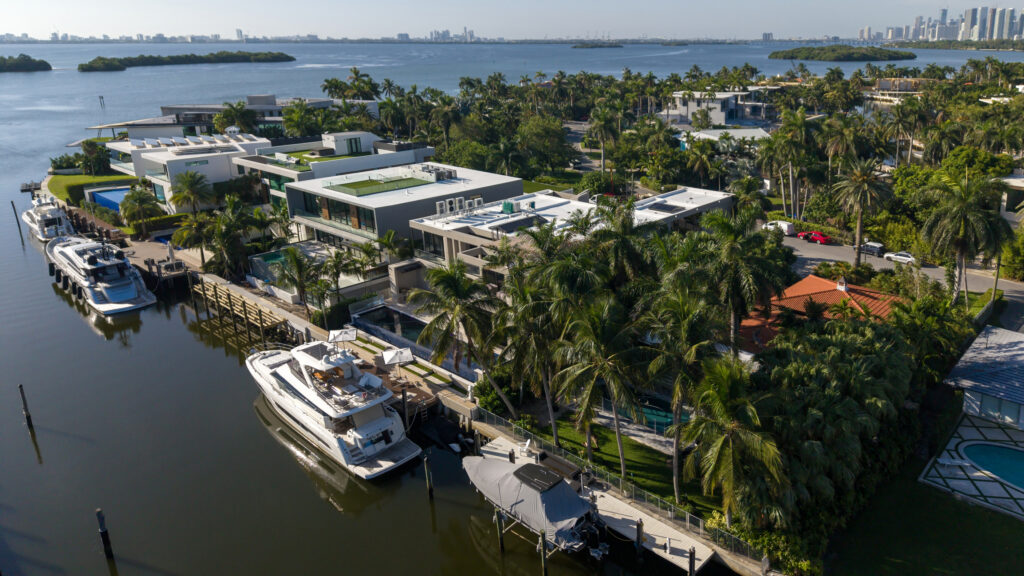
In March 2025, a buyer paid $17 million for a house on North Bay Road. Built in 1933, it had just under 6,900 square feet of living space on 20,100 square feet of land, with 240 feet of bay frontage. His agent then told the trade press exactly what the plan was: demolish the house and build a 10,000-square-foot spec mansion to sell for $60 million to $65 million.
That is the entire business model laid bare in print: $17 million for the dirt, and $60-plus million for what goes on it.
Many Miami sellers don’t realize that buyers aren’t always valuing the property’s existing home. They may actually be assessing what the lot allows them to create, minus every expense and obstacle standing between the land and that finished product. Understanding Miami land values is essential to knowing whether a buyer views your property as a home or a lot. Read on to determine whether to value your house or your land.
Miami Land Values Have Detached From the Houses Sitting on Them
The current data tells an unusual story.
In August 2026, Miami Beach single-family homes had a median sale price of $3,587,897, up 34.8% from a year ago. Across all property types in the same city, the median was $550,000, down 3.6%. Meanwhile, single-family homes take 155 days to sell and close at 91.2% of list price.
Coconut Grove home values tell the same story with a different accent. The Grove’s median sale price was $2.35 million over the trailing three months (up 46.9% year over year), with 97 days on market, an average sale roughly 6% below list, and a competitiveness score of 8 out of 100.
Prices sharply higher. Transactions slow. Almost no bidding.
Those conditions don’t normally travel together. When they do, it often means you’re looking at two distinct markets masquerading as one set of statistics.
- The Development Market: A narrow band of properties trades quickly because a developer has already determined what can be built on the lot.
- The End-User Market: Everything else sits on the market negotiating for four or five months.
The critical question for every owner is this: which market does your property belong to?
Three Ways to Find Out Determine Your True Property Value
Here are three ways to figure out whether your property should be priced for its dirt or its structure:
1. Pull your folio and read the assessment split.
The Miami-Dade Property Appraiser separates land value from building value on every parcel in the county, and it costs nothing to look up yours.
On August 27, 2026, a house on Irvington Avenue in Coconut Grove sold for $2,085,000. Despite being built in 1946 and sitting in a neighborhood where the typical listing takes 97 days to sell and closes roughly 6% below asking, it sold at full asking price after nine days on the market.
The county’s 2025 assessment offers an explanation: $1,020,500 attributed to the land and $179,535 to the building. Approximately 85% of the property’s value was the dirt.
Note: An assessor’s allocation is not true market value and was never intended to be. However it is public, free, updated annually and directionally useful in a way a standard comparative market analysis may not be.
2. Calculate your price per land square foot and compare it with what land near you has traded for recently.
Comparing Miami lot values per square foot reveals a steep appreciation curve that many owners overlook.
In July 2020, a 9,653 square foot lot in South Grove sold for $420,000 (~$43 per land square foot). Six years later, the Irvington Avenue property referenced above sold for approximately $266 per land square foot.
On Miami Beach, the Witkoff Group paid $8 million for a 17,700-square-foot waterfront lot on North Bay Road in October 2020 (~$452 per land square foot). They sold it in June 2025 for $24.25 million (~$1,370 per land square foot). The land tripled in value in less than five years, with no house on it at either sale.
Evaluating price per land square foot also reveals surprising dynamics when comparing waterfront versus dry lots.
Three months after the North Bay Road waterfront lot record, a non-waterfront North Bay Road property set the dry-lot record at $15 million on 10,980 square feet. That works out to approximately $1,366 per land square foot, just four dollars below the waterfront lot number.
Two very different assets. Two record sales. Essentially identical prices per square foot of land.
While two transactions alone don’t establish a rule, this shows that the waterfront premium sellers assume buyers will pay doesn’t always materialize.
3. Run the potential builder’s arithmetic backward.
Start with the likely finished value, then subtract construction, carrying costs, professional fees and the developer’s required profit margin. What remains is the true maximum residual value available for the land.
On the $17 million Miami teardown on North Bay Road, the buyer projected a finished value of $60 million to $65 million. Working backward from that figure justified the initial $17 million land purchase price.
Throughout North Bay Road, the Venetian Islands, and Coconut Grove, I see buyers looking at older structures who are no longer asking, “What can I renovate?” Instead, they’re asking, “What can I build?”
Local Zoning Regulations Dictate Miami Lot Values
Identical prices per square foot of land stop meaning identical things the moment zoning and regulatory friction enter the equation. Every regulatory constraint or environmental requirement directly reduces what a buyer can or will pay for the underlying land.
Coconut Grove: Environmental Factors
In Coconut Grove, much of the regulatory risk is biological. The Grove is governed by Miami 21 (Miami’s zoning code) and Neighborhood Conservation Districts 2 and 3, with portions also located within Environmental Preservation Districts.
Specimen trees pose a significant financial variable. The city defines a specimen tree as one with any individual trunk measuring 18 inches or more in diameter at breast height. Removing even one of these trees requires a permit and mitigation. Furthermore, the regulatory picture is evolving. Miami’s Tree Ordinance Advisory Committee is rewriting the city’s tree rules, while four tree-removal appeals are headed to the City Commission.
Imagine two Grove lots of the same size, on the same street, with the same zoning. One has a protected oak standing where the new house needs to go and the other requires no specimen tree removal. Those lots won’t receive the same offer, and the sellers will almost certainly be confused. They don’t realize that the tree has become a significant line item in the buyer’s calculation.
Miami Beach: Structural and Procedural Restrictions
On Miami Beach, regulatory friction is primarily procedural. Miami Beach is not governed by Miami 21; it has its own code. Three key provisions can materially affect what a site is worth.
- Maximum Unit Size: Capped at 50% of lot area in every single-family district, with two-story lot coverage capped at 30%. Variances are expressly prohibited.
- Lot Aggregation Limits: Generally, no more than two contiguous lots may generally be combined. Where a three-lot site is permitted, buildable area is calculated using only the largest two lots, turning the third into high-priced yard space.
- Pre-1942 Demolition Review: Outside a local historic district, single-family homes built before 1942 cannot receive a demolition permit until the city determines they are not architecturally significant. Determinations may be appealed, which can freeze development plans indefinitely.
- Minimum Seawall Elevation Requirements: For waterfront parcels, new construction or substantial seawall repairs (defined as work exceeding $300 per linear foot) trigger Miami Beach’s minimum seawall elevation requirement of 5.7 feet NAVD. On a property with 240 feet of waterfront, that threshold can be reached quickly.
None of this makes properties like the North Bay Road teardown bad investments. It does explain, however, why a buyer discounts for time, construction obligations and uncertainty.
I’ve personally seen how quickly a property’s value equation can change once a buyer identifies the condition of a seawall, the location of a protected tree or a possible demolition review. One physical or regulatory constraint can alter the entire site plan, and sellers are often unaware of how these calculations affect the market value of their property.
So Which Type of Property Do You Own?
To determine whether your property is a development site (value is concentrated in the dirt; structure is an impediment or removal cost) or end-user home (value is concentrated in architectural integrity, condition, and immediate livability), ask yourself four questions:
- What does the county appraiser’s land-to-building allocation say about your folio?
- What is your lot worth per square foot compared to recent land sales nearby?
- Would a builder’s finished product leave enough margin to support your asking price?
- What physical or regulatory hurdles (trees, seawalls, historic reviews) sit within the buildable footprint?
If the land carries the value, you own a development site and should be speaking with people who know how to price development sites. If the house genuinely carries the value, its architecture, condition and presentation are worth real money, and it should be marketed as a home.
Using the wrong playbook is an expensive mistake. Renovating the kitchen in a home the next buyer intends to demolish is setting money on fire. Conversely, marketing a genuinely valuable home as a teardown leaves significant equity on the table.
Discover What Your Property Is Truly Worth
Asking “what is my Miami home worth?” requires looking beyond standard comps to evaluate your property’s true development potential. Whether you own an architectural home or a prime lot, positioning it correctly is the key to maximizing your return. Request a free customized property valuation analysis today.
Next in this series, I will examine waterfront land dynamics, where the gap between house value and land value is wider than anywhere else in Miami.
Barbara Gretsch is a REALTOR® with Berkshire Hathaway HomeServices EWM Realty, serving Miami and South Florida’s $1M+ residential market, including Coconut Grove, Coral Gables, The Roads, Brickell, Key Biscayne and Miami Beach. barbaragretsch.com
If you’d like to receive my posts in your inbox each week, subscribe to my Substack.