
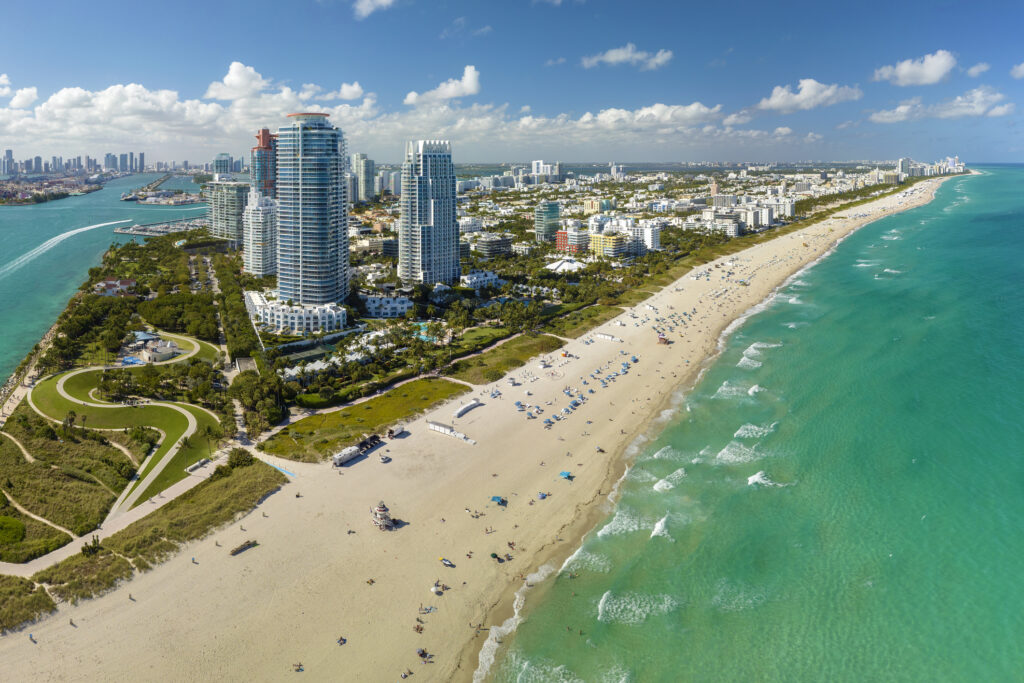
This January, Google co-founder Larry Page reportedly paid $173 million for two adjacent waterfront estates in Coconut Grove. In March, Mark Zuckerberg reportedly closed on Indian Creek at a price that set the Miami-Dade residential record. In February, Palantir quietly moved its principal executive office to Aventura. Four corporate headquarters relocated to South Florida in the first two months of the year, and in every case the chairman or chief executive had already bought a home here first.
Notice the order of operations. The house comes before the headquarters. That is not a coincidence, and it is not about the weather. It is a tax strategy executed in real estate, and it is the most important thing happening in the Miami market right now.
The math doing the moving
California’s top marginal income tax rate is 13.3 percent, and Sacramento spent the last year debating a wealth tax on top of it, a proposed one-time levy on assets above a billion dollars tied to residency as of January 1, 2026. Whether or not that bill ever collects a dollar, it did something more valuable for Miami than any ad campaign could. It put a deadline on a decision the money had been circling for years.
Florida’s state income tax is zero. No state tax on capital gains. No state estate tax. For someone whose equity just repriced on the AI run, the spread between 13.3 percent and zero is not a lifestyle preference. It is the single largest controllable line item in their financial life, and unlike the market, it is entirely within their control.
Why the second home comes first
Here is the part most coverage misses. Almost nobody relocates a life in one step, and the wealthiest buyers do not start by changing their domicile. They start by buying the house.
I will be straight about what a second home does and does not do, because plenty of people writing about this are not. A second home in Florida does not get you the homestead exemption, and owning one does not change your income tax bill by itself. Florida’s tax advantages attach to residency, not to a deed. Residency has real requirements: the 183-day rule, a declaration of domicile, the license, the practical evidence that your life actually moved.
What the second home buys you is the option, and the option is the whole play. The buyers doing this well establish the position now and let the domicile decision follow on their own timeline. When the liquidity event arrives, the sale, the secondary, the vesting cliff, the fund distribution, they are already Florida residents when it happens. The ones who waited are writing a thirteen percent check on the largest number of their lives. On a $100 million gain, the difference between deciding early and deciding late is more than the house cost.
The honest ledger on the other side: Miami-Dade property taxes run near two percent of assessed value with no cap for non-homestead property, and insurance on the water is a real number that deserves real diligence. For the buyer this post is about, both are rounding errors against the income tax spread. I am a REALTOR®, not a tax advisor, and the residency mechanics belong with your CPA and your attorney. Choosing the right asset is my side of the table.
What that money is actually buying
Watch the purchases, not the press releases. The pattern is specific: waterfront and island scarcity first, turnkey service second.
The Grove purchases were not a surprise to me. I have been making the argument all year that Coconut Grove’s value sits on a short, finite waterfront spine that cannot be expanded, and that the inland blocks borrow the name without the scarcity. When the most sophisticated capital in the country picks the Grove waterfront over every other option in Miami, that is the thesis being validated at nine figures. I lay out the full argument in my Coconut Grove guide.
For the second home specifically, though, most of this wave is not buying a compound. A compound needs staff. The lock-and-leave buyer, here forty days a year while the residency plan matures, wants a building that runs itself: branded service, full-floor privacy, a protected water view, and nothing to think about between visits. That is the quieter southern stretch of Brickell, the Mandarin Oriental and St. Regis end of the avenue, and the oceanfront collections on Miami Beach. Scarce product with a service moat is what holds its value when the commodity towers compete on price.
My position
The tax math gets this buyer to Miami. It does not tell them what to buy, and that is where the outcomes will separate. A second home purchased as a placeholder, in a commodity tower or on the wrong block, is just carrying cost with a view. A second home purchased as an asset, irreplaceable location, real architecture, protected water, becomes the best-performing line on the balance sheet by the time the domicile paperwork is filed.
Buy the scarcity, not the zip code. That has been my position in every neighborhood I cover, and the last six months of purchases by people with unlimited options have made the case better than I can.
If you are looking at Miami from California or New York and want a straight read on buildings, blocks, and what the numbers actually support, contact me. I will send current availability and tell you what I would buy and what I would skip.
Barbara Gretsch is a Miami Luxury REALTOR® with Berkshire Hathaway HomeServices EWM Realty. Nothing here is tax or legal advice; confirm residency and tax questions with your CPA and attorney. Reported transaction details are drawn from public coverage.