
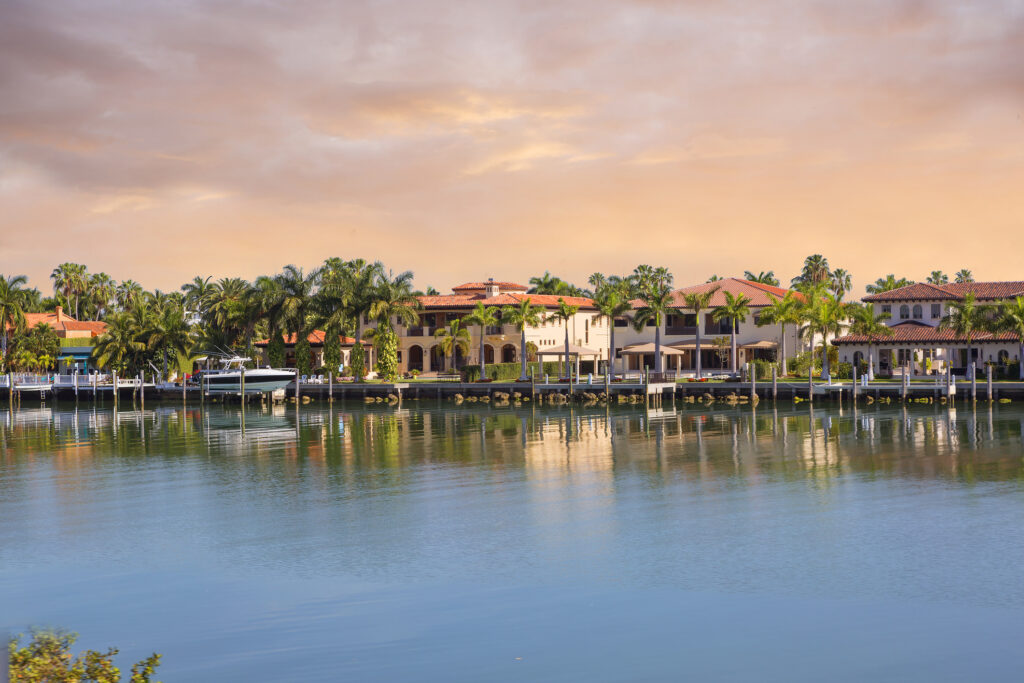
A few weeks ago, I analyzed what Miami waterfront lots are actually worth, but I left one key question unanswered: Is open bay frontage really worth the premium over a wide, deep-water canal?
The short answer is yes, sometimes. However, the view alone doesn’t tell the full story. Understanding how features like water depth, dockage, bridge clearances and structural readiness impact Miami waterfront property values can mean a huge difference at the closing table.
To see this in action, consider two recent sales in the same guarded island community:
- 270 South Hibiscus Drive: Sold at approximately $429,000 per linear foot of waterfront.
- 93 Palm Avenue: A cleared lot with 100 feet of direct open bay frontage sold three weeks earlier for $21 million, coming to $210,000 per linear foot.
Same guarded gate. Same open bay frontage. Yet one traded at nearly half the price per foot of the other. The key takeaway for any buyer or seller is simple: It’s not merely what you can see from the shore, but what you can actually use.
Read on to discover how open bay and canal properties stack up, what hidden factors drive real market value and the two crucial items buyers must inspect before making an offer on a Miami waterfront home.
Open bay frontage doesn’t tell the whole story.
If open bay frontage alone determined value, these two properties would not have traded at such different prices.
The distinction came down to immediate usability and structural improvements:
- Hibiscus Drive included a move-in ready home and two docks capable of accommodating a yacht up to approximately 105 feet.
- Palm Avenue was simply a cleared waterfront lot.
One buyer purchased a completed, turnkey luxury asset. The other purchased the opportunity (and risk) of spending the next several years designing, permitting and building one. That’s an important distinction.
When evaluating Miami waterfront property, buyers aren’t just purchasing “open bay.” They’re paying for a complete package: linear frontage, water depth, boat access, privacy, exposure and (in some cases) existing construction. The view matters, but so does everything attached to it.
Open bay doesn’t necessarily mean deep water.
Assuming open bay frontage automatically equals deep water is one of the most common (and potentially expensive) assumptions buyers make.
Biscayne Bay is shallow. Its average depth is less than six feet. Furthermore, much of the usable waterfront depth in Miami was created through dredging, and that depth has to be maintained.
A property can feature an extraordinary two-mile open bay view and still lack enough water at low tide for a large sportfishing boat or motor yacht. Meanwhile, a canal several streets inland may have been dredged deeper and provide better boating access.
Buyer Tip: Always ask for exact measurements at Mean Low Water (MLW) taken at the dock. “Deep water” is a marketing description. Exact bathymetric measurements are what matter.
A good wide canal can offer several advantages.
While open bay frontage is in high demand, a wide, well-located canal offers distinct practical advantages when comparing open bay vs. canal Miami real estate:
- Protection & Reduced Maintenance: A canal property generally has less exposure to wind, waves and boat traffic than a home facing miles of open water. That can affect the dock, the seawall and ultimately the cost of maintaining both.
- Cost-Effective Dockage: Canals may also provide more practical dockage for the money. Calmer water makes it easier to secure and maintain a larger vessel without engineering the dock for constant exposure to bay chop. (This is why many serious boaters prefer the protected side of Key Biscayne.)
- Enhanced Privacy: Open bay views offer endless horizons, but they also bring heavy boat traffic and high visibility. A wide canal provides a more intimate, private waterfront setting.
The Trade-off: What a canal cannot provide is a completely unobstructed view. That is the true open-bay premium, and it’s the one feature that cannot be added during a renovation.
Investigate these two essential features before buying.
Whether considering open bay or canal frontage, examine these two key technical factors prior to writing an offer:
Fixed Bridges and Overhead Clearance
If fixed bridges sit between the property and open water, vertical clearance limits the size of vessels you can accommodate.
For instance, the Venetian Causeway includes 12 bridges, 10 of which are fixed. Miami-Dade County plans to replace 11 of these bridges to increase vertical clearance. However, official specifications regarding exact clearances per span have not yet been released. Buyers evaluating nearby waterfront properties should factor these expected infrastructure changes into their decision.
Seawall Condition and Elevation Requirements
Seawalls have become a primary focal point in high-end waterfront negotiations.
In Miami Beach, repair work costing $300 or more per linear foot is classified as a “substantial repair.” As discussed in my waterfront lot analysis, crossing this threshold (which takes just $30,000 on a lot with 100 feet of waterfront) triggers mandatory compliance with the city’s 5.7-foot NAVD elevation requirement.
Sophisticated buyers now evaluate seawall condition and elevation with the same seriousness they apply to a roof or foundation. Many sellers have not yet adjusted to this reality.
So, which waterfront option is worth more?
If the buyer’s primary priority is an unobstructed view and boat access is secondary, open bay will almost always command the premium.
If the buyer owns a particular vessel, the answer is more complicated. It depends on water depth at low tide, bridge clearance, access to open water, turning room and usable dockage. A good canal property may perform better on all of those points while selling for considerably less per foot of waterfront.
Two properties on the same islands sold three weeks apart at nearly twice the price per linear foot. The difference was not simply the water. It was the house, the dock and what the buyer could do with the property immediately.
Looking to Value or Acquire Miami Waterfront Real Estate?
Determining how the market values frontage, boating access, seawall condition and views requires local expertise and precision analysis. Whether you’re considering selling your property or evaluating a purchase, I can help you uncover the true market value.
Barbara Gretsch is a REALTOR® with Berkshire Hathaway HomeServices EWM Realty, serving Miami and South Florida’s $1 million-plus residential market, including Coconut Grove, Coral Gables, The Roads, Brickell, Key Biscayne and Miami Beach. barbaragretsch.com
If you’d like to receive my posts in your inbox each week, subscribe to my Substack.