
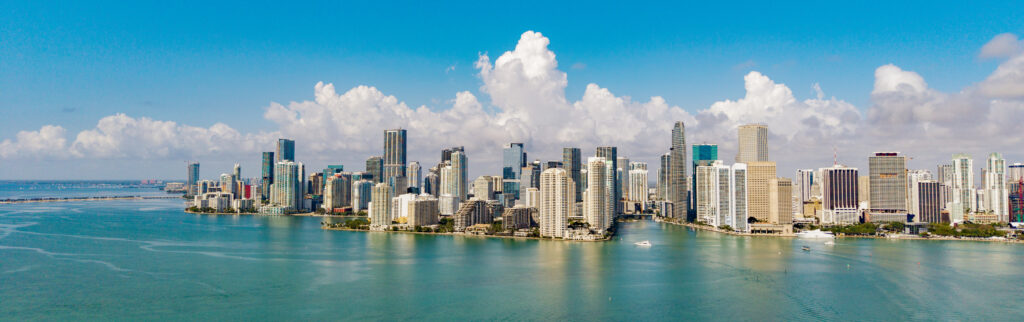
Is the Miami real estate market cooling or maturing? Learn why the $1M+ market is behaving differently in 2026 and which neighborhoods are holding their value despite rising inventory.
The Miami real estate market in 2026 is no longer driven by headlines or hype.
It is being shaped quietly by separation.
Not between winners and losers, but between assets that are built to endure and those that are priced for a moment that has already passed.
What we’re seeing now is not a market in retreat. It is a market in refinement. Understanding where that refinement is occurring is what allows buyers and sellers to move forward with confidence rather than caution.
The Miami Real Estate Market Is No Longer Moving as One
One of the clearest signals coming out of the 2025 data is that Miami is no longer behaving like a single market.
Single family homes and condominiums are responding differently to current conditions.
According to the Berkshire Hathaway HomeServices EWM Realty market data, single family homes continue to show relative stability in pricing even as inventory has increased year over year. Condominiums, by contrast, are carrying materially higher months of supply—particularly in older buildings and at price points where buyers are more sensitive to monthly costs and future uncertainty.
Sub 1 Million Versus 1 Million Plus Is the Real Divide
Perhaps the most important distinction as we move into 2026 is not simply property type but price tier.
The Miami real estate market above one million dollars is behaving very differently from the market below it.
Buyers in the one million plus segment tend to be less rate sensitive and more balance sheet driven. They are focused on quality, location, and long term positioning rather than short term fluctuations.
The data reflects this. While overall transaction volume has moderated, pricing in the one million plus segment has remained comparatively resilient, particularly for well located single family homes and premium condominium assets with strong fundamentals.
This is not speculative demand. It is intentional demand.
These buyers are not trying to time the market. They are selecting assets they can live with and hold through cycles.
Inventory Does Not Mean Weakness
One of the most common misinterpretations I see right now is equating higher inventory with falling values.
Yes, inventory is up year over year in many segments. No, that does not automatically translate into price erosion.
Much of today’s inventory reflects sellers adjusting expectations after peak years, buyers taking more time to decide, and a healthier balance between supply and demand.
In other words, the market is functioning.
Properties that are priced correctly, well located, and aligned with current buyer expectations are still trading. Those that are not are simply taking longer, which is exactly how a normalized market behaves.
Where Value Is Holding
As we look toward 2026, the areas of relative strength in the Miami real estate market are increasingly clear.
Well located single family homes continue to benefit from land scarcity, livability, and long term desirability.
In neighborhoods like Coconut Grove, demand remains anchored by limited supply, serious buyers, and a lifestyle that continues to attract both primary residents and long term capital. Homes that offer walkability, proximity to the village core, or established tree canopy are still seeing steady interest even as buyers become more selective.
In Brickell, the story is more precise. Newer, well capitalized condominium buildings with strong management, modern construction, and clear reserve planning are separating themselves from older buildings facing rising costs and buyer hesitation. The Brickell market has not weakened. It has become more discerning.
Across both neighborhoods, the common thread is quality over convenience and fundamentals over flash.
The one million plus buyer is still active, but far less forgiving.
Where Even Sophisticated Buyers Misread the Moment
One pattern I continue to see—even among experienced buyers—is the tendency to confuse a slower market with a weaker one.
A slower market invites better decisions. It does not invalidate good assets.
Some buyers pause, waiting for a broad pullback that never arrives in the specific locations or property types they actually want. Others focus too heavily on macro headlines and miss micro level opportunity—the block, the building, the financial health behind the property.
In today’s Miami real estate market, outcomes are driven less by timing and more by selection.
Looking Ahead to 2026
Miami real estate is entering a more disciplined and mature phase.
This environment favors buyers who value optionality, liquidity, and long term positioning. It also favors sellers who understand that today’s market rewards realism rather than nostalgia.
The strongest decisions in 2026 will not be driven by urgency or fear. They will be driven by clarity.
Understanding where the market is holding strong and why allows thoughtful strategy to create meaningful advantage.
Thinking about making Miami your next home?
Let’s talk. I’ll help you find the property that makes both financial and emotional sense.
Barbara Gretsch, REALTOR®
Berkshire Hathaway HomeServices EWM Realty
📱 +1 773.208.2992 (Call or WhatsApp)
📧 barbaragretsch@gmail.com
🌐 www.barbaragretsch.com
Barbara Gretsch is a REALTOR® with Berkshire Hathaway HomeServices EWM Realty, serving Miami and South Florida’s $1M+ residential market, including Coconut Grove, Coral Gables, The Roads, Brickell, Key Biscayne, and Miami Beach. barbaragretsch.com