
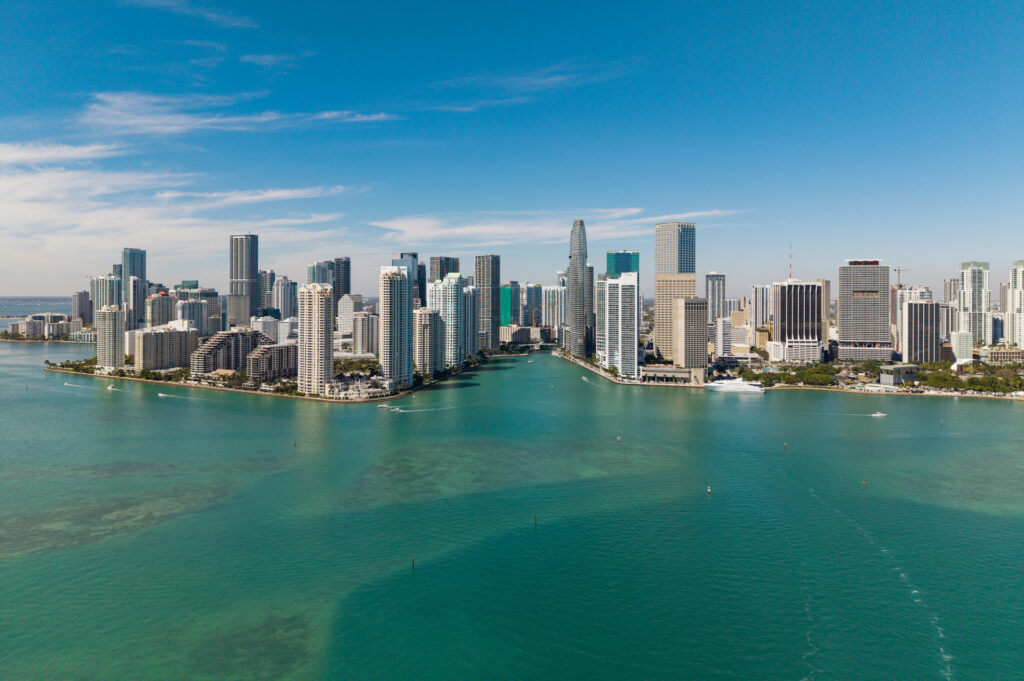
There’s a stretch of Brickell Avenue below Fifteenth Road where the banyans still close over the street and the noise level seems to drop. I notice it every time I’m heading to a showing in one of the older bayfront buildings. A few blocks north, you’re surrounded by new glass towers. Then suddenly you’re under a canopy that has been there far longer than almost anything else in 33131/33129.
That sudden contrast is a great physical reminder of why neighborhood averages fail to answer the question, “What is my Brickell condo worth?” Quoting a general zip code average is a singularly unhelpful response. Macro-level numbers show broad trajectory, but they cannot tell you what your specific unit will command on the open market.
The 33131/33129 Macro Picture: Growth vs. Supply
Brickell’s $1M+ luxury market numbers show clear momentum on the surface, but the underlying metrics reveal a distinct split:
- Q1 2026 Median Sales Price: $1,675,000 (a 13.9% increase year-over-year)
- Price Per Square Foot: $950 (an all time high)
- Median Days on Market: 75 (the fastest pace in greater downtown Miami)
- Luxury Inventory Supply: 28 months (up from 24 months last year)
A market posting a fast 75 days on market while simultaneously carrying 28 months of total inventory tells a critical story: Brickell is not one uniform market. Well-positioned units are moving quickly; others are sitting indefinitely.
What Actually Sets Your Brickell Condo’s Value
I’ve toured units in the same building and the same vertical line, just a few floors apart, that require completely different pricing strategies:
- Floor, Exposure, and Light: Micro-location within the building dictate pricing. Exposure matters significantly in South Florida. A north-facing unit in August offers a drastically different living experience than a west-facing unit absorbing late-afternoon sun.Buyers who know Miami understand that.
- The Arrival Experience: Exterior maintenance, lobby appearance, hallway finishes, and staff attentiveness set immediate buyer perceptions. I recently walked a unit that showed beautifully, but the tired, neglected common areas dragged down its actual market value. Buyers acquire the entire building, not just the apartment.
Elements like this are an increasingly important part of the value calculation.
The New Lending Hurdle: Fannie Mae & Freddie Mac Policy Shift
As of August 3, 2026, Fannie Mae retired its Limited Review process and Freddie Mac eliminated Streamlined Review. Condominium projects with more than ten units now face mandatory Full Review requirements regardless of down payment size or the buyer’s credit strength.
As a result, lenders are actively dissecting:
- Annual operational budgets and structural reserve funds
- HOA meeting minutes and pending litigation
- Insurance coverage and engineering inspection reports
For a seller, the important takeaway is simple: Your buyer can be financially unqualified purely because of your building’s documentation.
Out of 2,397 condo buildings across Miami-Dade, Broward, and Palm Beach, only 21 are approved for FHA loans. That’s less than 1%. The new policies widen the performance gap. Associations with clean financials, healthy reserves, and completed milestone inspections will pull away from buildings carrying unresolved deferred maintenance.
The Cash Buyer Cushion (And Where It Breaks Down)
Strict conventional financing rules do not impact all price points equally due to South Florida’s high volume of cash transactions:
- Countywide Cash Purchases: 48.5% of all existing condo sales (June 2026).
- Luxury Cash Purchases ($1M+): 82% closed all-cash in 2025, with $1M+ transaction volume climbing 29.1% in June 2026.
Based on these numbers, lending rules do not directly affect a large portion of Brickell’s luxury buyer pool. If you own a $2.4 million bayfront unit, your buyer will likely pay cash, bypassing lender review hurdles. However, if you own an $850,000 unit in a building facing reserve deficits or upcoming special assessments, conventional financing becomes much more important. A restricted lending pool shrinks your buyer pool, potentially depressing your achievable sale price.
Strategic Checklist: Preparing to List This Fall
If I were selling a Brickell condo this fall, here’s what I would do before scheduling photography or putting the property on the MLS:
- Audit the Association: Gather the current budget, reserve study, meeting minutes, and insurance policies. Address potential buyer flags upfront. If the building is in good financial condition, that should be part of the property’s positioning from day one. If there’s a problem, I would rather know about it before listing than discover it after accepting an offer.
- Isolate Specific Comps: Evaluate recent closed sales from the exact building line, comparable floor heights and exposure, and similar renovation quality (rather than Brickell as a whole). In June 2026, Miami condos sold at a median of 94% of original list price with a median 85 days to contract (up from 68 days a year earlier). That tells me buyers are there, but they’re not blindly paying asking prices.
- Price Against True Competition: Base your ask on completed, verified sales rather than active neighborhood wishful-thinking listings.
I recently sat with an owner who had a number in mind based largely on what other units in the neighborhood were asking. Once we looked at the actual closed sales, the competing inventory and the differences between those units and theirs, the picture changed. That’s a conversation I would much rather have before going to market than after a property has been sitting for three months.
Brickell Is Sorting: Sound Buildings vs. Vulnerable Inventory
Last week I wrote about what the new condo tower pipeline is doing to Brickell resale values. This is the other half of the current Brickell condo market story.
The Brickell market isn’t simply “strong” or “soft.” It is actively sorting. Buildings with solid financial reserves, attentive management, and offerings that aren’t easily duplicated elsewhere are pulling ahead of those struggling with aging infrastructure and poor documentation. The new lending environment only makes those differences easier to see.
If you own a condo in 33131 or 33129 and need an accurate assessment of its market position, I will run a hyper-targeted comparative analysis looking at your specific line, floor elevation, and building financial profile. No broad zip code average. Just the comps that matter and the reasoning behind the number.
Brickell Seller Questions I’m Getting This Month
Does the August 3 lending change affect me if I’m selling to a cash buyer?
Not directly. But it can affect the value of properties in your building over time. If future buyers in your building cannot secure conventional mortgages, overall resale demand drops, reducing price appreciation across all units in the line.
My building has a special assessment. Is my unit unsellable?
No. A special assessment does not automatically make a condo unsellable, but transparency is mandatory and the details matter. A fully funded or completed structural project with a satisfied assessment is viewed by buyers as a building upgrade, whereas an open-ended assessment with uncertain final costs creates pricing friction.
That’s why it’s crucial to understand the building before deciding how to price any given unit.
Ready to Find Out What Your Brickell Condo Is Really Worth?
Get a detailed, line-item valuation of your Brickell property based on actual closed comps, current inventory, and building financial health.
Barbara Gretsch is a REALTOR® with Berkshire Hathaway HomeServices EWM Realty, serving Miami and South Florida’s $1M+ residential market, including Coconut Grove, Coral Gables, The Roads, Brickell, Key Biscayne, and Miami Beach. barbaragretsch.com
If you’d like to receive my posts in your inbox each week, subscribe to my Substack.